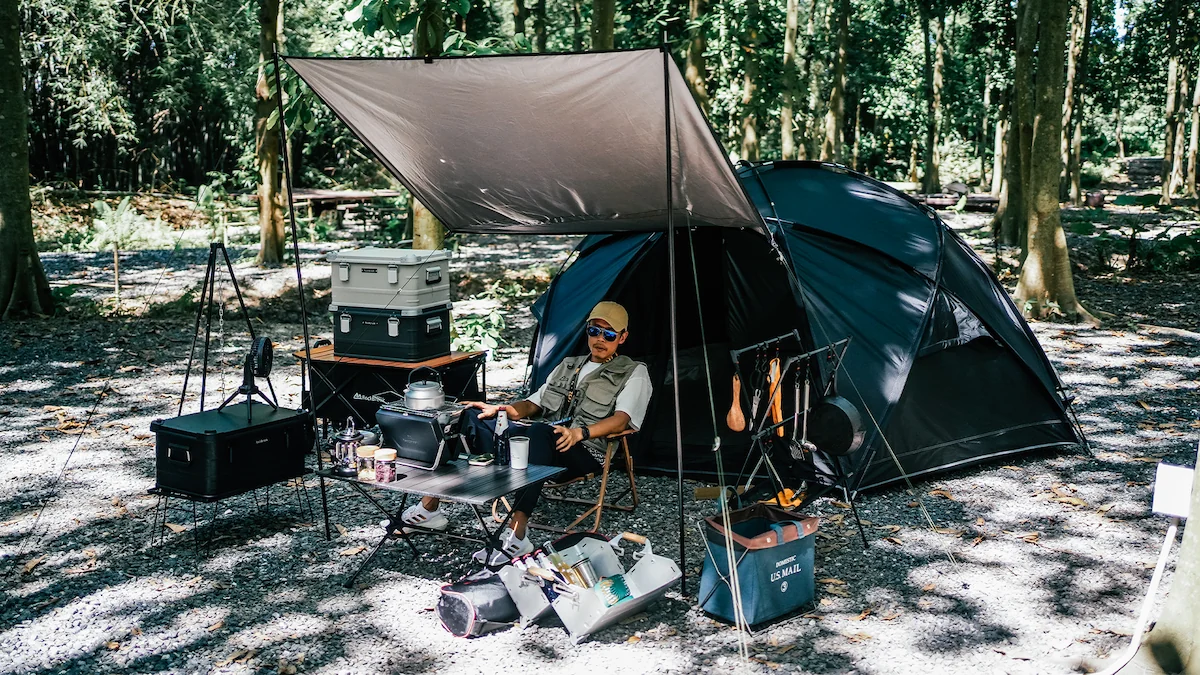
Choose the workflow before the box
A good camping kitchen box stores the gear you actually use, opens without dismantling camp and creates a stable outdoor work area. Start with a packing list and loaded-weight target, then choose capacity and material. For many two-person car trips, 30–50L is a more manageable starting range than the largest available chest.
Camping kitchen box, chuck box or patrol box?
The names overlap. A chuck box traditionally means a portable cabinet for cookware, utensils and food preparation. A patrol box is the Scouting-style variation, often wooden and opened on a camp table. A modern camping kitchen box may use aluminum or plastic, add its own legs and turn a lid or panel into a work surface. A plain storage tote can still be the right answer if it is organised well.
The useful distinction is not the label. Ask whether the product stores, presents and supports the kitchen without adding unnecessary setup steps.
A box may become a preparation surface, but a fuel-burning stove must be used outdoors with ventilation and the clearances required by its manufacturer. Never run it inside a Tesla or another enclosed vehicle.
Build a real packing list
Do not choose litres from a marketing photo. Lay out one trip's actual kitchen: pot, pan, stove, fuel stored safely, kettle, plates, cups, utensils, wash kit, lighter, cloths and food containers. Remove duplicates and items that can live elsewhere. Measure the largest rigid object because it often controls the box dimensions more than total volume.
- Keep a core kit: the same utensils and wash items stay packed between trips.
- Separate consumables: food, water and fuel may need different storage and handling.
- Allow dry space: clean cloths and paper goods should not share a wet compartment.
- Leave working room: a box packed to the lid becomes difficult to use and repack.
Capacity versus loaded weight
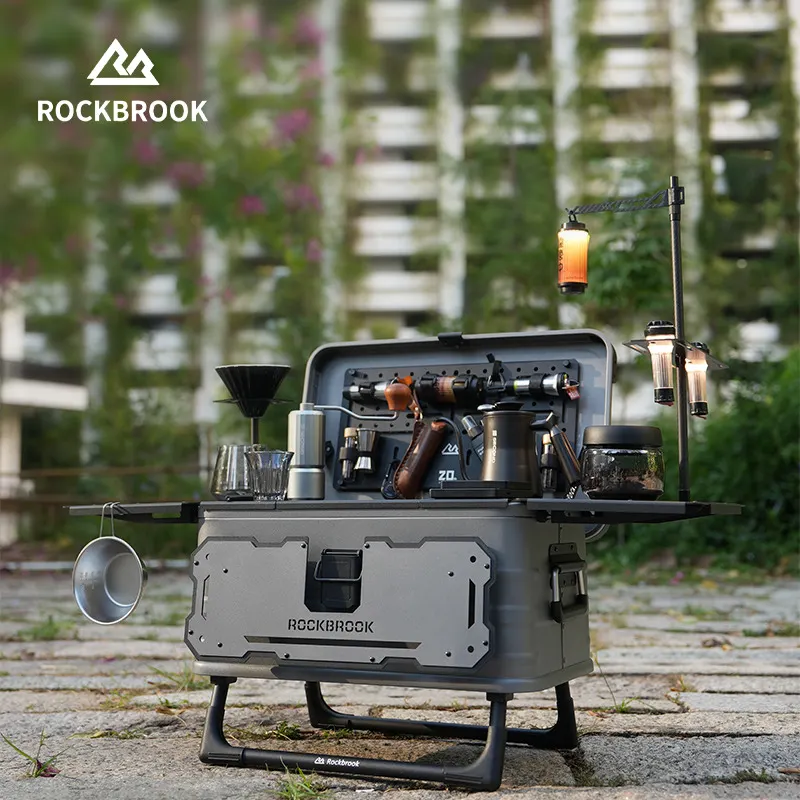
Volume is attractive because it is easy to compare, but weight determines whether the system is pleasant to use. Rockbrook lists the 30L BX1026 at 8.8 kg empty, the 50L BX1024 and BX1025 at 11 kg, and the 60L BX1027 at 11.5 kg. Add cookware, food and water and the lift can quickly become a two-person task.
For a kitchen that is unloaded every night to make room for a Tesla mattress, a smaller box or two lighter modules can be better than one large chest. Two modules also let you separate cooking equipment from dry food, although they require more restraint points while driving.
| Capacity range | Likely role | Main advantage | Main risk |
|---|---|---|---|
| 20–30L | Minimal or two-person kitchen | Easier lifting and placement | Bulky pans may not fit |
| 40–50L | General car-camping kitchen | Balanced storage and organisation | Heavy when fully loaded |
| 60L+ | Long trips or group equipment | Fewer loose items | Large footprint and difficult lift |
Access matters when the lid becomes a table
A top-opening box is simple and weather-friendly, but the lid stops being useful as a work surface whenever something inside is needed. Front or side access solves part of that conflict. It also helps in a loaded vehicle where another item sits above the box.
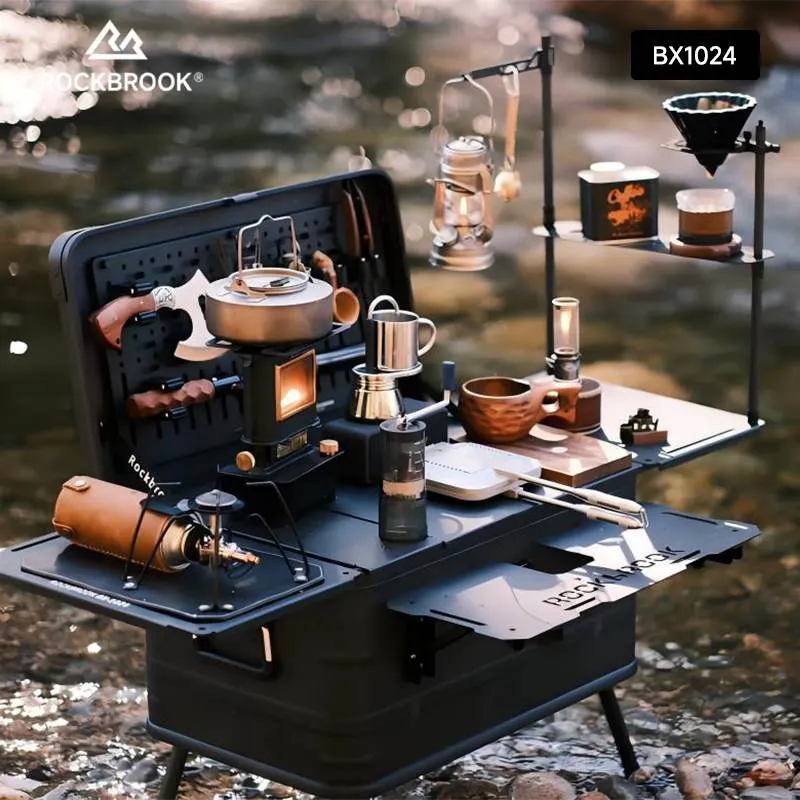
Rockbrook's lineup demonstrates the trade-off: BX1024 is a straightforward 50L top-access box that can act as a table; BX1026 adds quick front access and a side table; BX1027 uses a side opening and larger integrated surface. These are examples, not proof that one layout suits every cook.
Compare material, hardware and maintenance
| Material | Why people choose it | Inspect before purchase |
|---|---|---|
| Aluminum | Rigid, corrosion-resistant shell and premium hardware | Panel thickness, corner protection, latch quality, seal and empty weight |
| Plastic | Light, affordable and widely available | Lid stiffness, temperature brittleness, hinge design and stacking access |
| Plywood | Repairable and easy to customise | Moisture sealing, joints, overall weight and transport footprint |
Whatever the material, dry the box before storage, clean food residue and inspect latches and fasteners. Do not leave a sealed kitchen box with moisture trapped inside.
A simple zone layout
Fast access
Lighter, headlamp, knife in a sheath, cloth and one utensil roll. These should be reachable without unpacking the main compartment.
Cookware
Nest pot, pan and kettle; use cloth dividers to reduce noise and protect coatings while driving.
Wash and waste
Keep soap, brush, basin and waste bags isolated from dry ingredients and ready for responsible disposal.
A modular insert or removable pouch is often more useful than dozens of permanent dividers. It can move to a picnic table and makes the box easier to clean.
Design around the sleep conversion
Model Y, Model 3, Model X and Cybertruck owners have different cargo geometry, but the same planning rule applies: the box cannot occupy the mattress space at night without somewhere else to go. Measure the exact car and decide whether the packed kitchen moves outside, to a seat, or remains in a separate cargo zone.
- Use non-slip padding where metal could contact interior trim.
- Secure the closed box to appropriate cargo points for travel.
- Keep heavy items low and avoid loose hardware.
- Test the lift at the expected loaded weight before a long trip.
- Plan a rain-safe outdoor location; do not cook in the vehicle.
When a premium box is worth it
Choose a purpose-built camping kitchen when you camp often enough that setup friction matters, need a stable raised surface and will maintain one repeatable kit. Choose a plastic tote when price, low weight and occasional use matter most. Build a wooden chuck box when custom compartments are worth the bulk and maintenance.
If Rockbrook is on the shortlist, compare its current official listings and read our Rockbrook review. Prices in our comparison were checked on 23 July 2026; the live cart, shipping quote and return eligibility remain the final authority.
Rockbrook and camping-box FAQ
What size camping kitchen box do I need?
Start with the equipment you actually use and the largest rigid item. Around 30L can suit a compact two-person setup, while 40–50L offers more general car-camping space. Loaded weight and exterior dimensions matter more than litres alone.
What is the difference between a chuck box and a camping box?
A chuck box is traditionally a portable camp-kitchen cabinet with organised access and a work surface. A camping box can mean any storage container. Modern products often combine both ideas with aluminum shells, stands and fold-out panels.
Should I choose aluminum or plastic?
Aluminum is rigid and often supports integrated hardware, but it costs and weighs more. Plastic is lighter, cheaper and practical for occasional trips. Compare lid strength, latches, access and total loaded weight.
Where should a kitchen box go when sleeping in a Tesla?
Plan that before buying. Depending on measured dimensions and occupancy, it may move outside under suitable cover, behind the front seats or onto a front seat. It must be secured while driving and kept clear of the sleeping surface.
Compare ready-made camping kitchens
Use this checklist against Rockbrook's current 30L, 50L and 60L boxes, then confirm the delivered total and return eligibility.